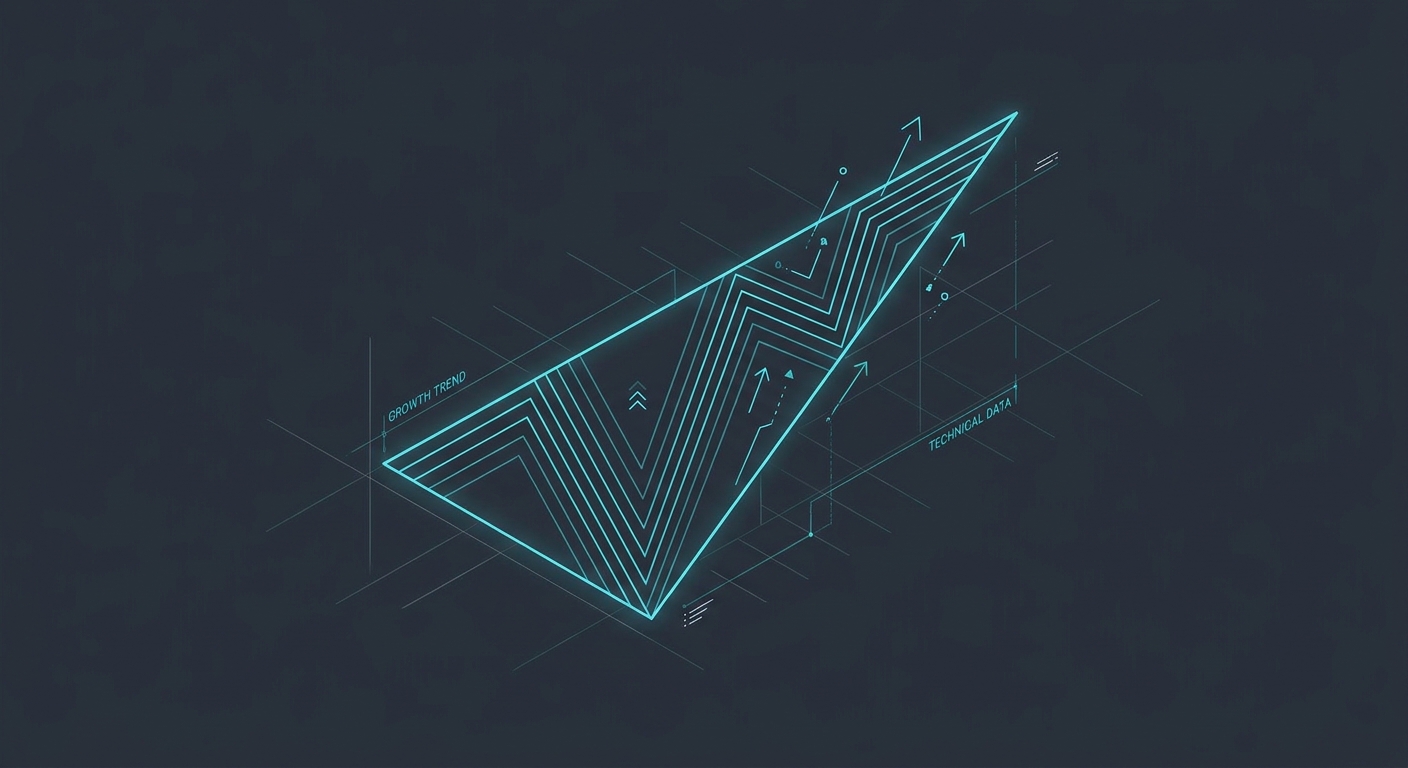
Most traders lose money at the end of a mature trend because they mistake overlapping price action for a bullish base.
When a market grinds higher into a narrowing range with overlapping swings and fading volume, it is usually printing an ending diagonal. In Elliott Wave theory, this structure marks the absolute exhaustion point of a cycle. It is one of the most reliable reversal setups in technical analysis when you know how to audit its internal structure.
What Is an Ending Diagonal?
An ending diagonal is a motive pattern that appears exclusively in terminal positions: Wave 5 of an impulse move or Wave C of an A-B-C correction.
While standard impulses drive forward with clean five-wave legs and zero overlap between swings, an ending diagonal reflects a structural fight where buyers are running out of dry powder.
Standard Impulse (5-3-5-3-5):
- Wave 4 NEVER enters Wave 1 price territory
- Subwaves 1, 3, and 5 are five-wave structures
- Acceleration and expanding spread

Ending Diagonal (3-3-3-3-3):
- Wave 4 ALWAYS overlaps Wave 1 price territory
- Every subwave (1, 2, 3, 4, 5) subdivides into 3 waves
- Boundary lines converge into a rising/falling wedge
- Decelerating speed and contracting spread
The Rule of 3-3-3-3-3
The internal subwave count is the lie detector for diagonals.
In a normal impulse, motive waves advance in five distinct legs. In an ending diagonal, buyers cannot muster the momentum for a five-wave push. Every single leg (subwaves 1, 2, 3, 4, and 5) subdivides into a three-wave A-B-C zigzag.
This 3-3-3-3-3 structure explains why price action inside an ending diagonal feels choppy, difficult, and prone to violent intraday whip. Every push to a new marginal high is immediately met by profit-taking and counter-trend supply.
The Four Diagnostic Rules
To confirm an ending diagonal on your chart, verify these four criteria:
- Terminal Location: The pattern appears only at the end of a larger trend (Wave 5 of an impulse or Wave C of a corrective flat/zigzag). Finding this in a Wave 1 or Wave 3 position disqualifies the pattern.
- Subwave Structure: All five legs break down into three waves (3-3-3-3-3).
- Price Overlap: Wave 4 must overlap the price peak of Wave 1.
- Converging Boundaries: Trendlines connecting the extremes of Waves 1 and 3, and Waves 2 and 4, must converge toward an apex.
The "Throw-Over" Trap
The most dangerous phase of an ending diagonal is the finale in subwave 5.
As price approaches the upper contracting trendline, it frequently punches through the boundary on a temporary burst of volume. Elliott termed this move the throw-over.
Breakout traders see the line break and rush in to chase momentum. In reality, the throw-over represents exit liquidity for smart money distributing their final inventory.
The tell is an immediate failure: price rejects back inside the converging trendlines within 1 to 2 bars. Once the throw-over fails, the resulting reversal is typically swift and violent.
Trading the Reversal
Because ending diagonals represent terminal exhaustion, their resolution is dramatic. The market retraces the entire diagonal structure quickly, usually returning to the origin where subwave 1 began.
1. Invalidation
An ending diagonal is invalidated if Wave 3 is the shortest wave (Wave 3 can never be the shortest motive wave in Elliott Wave theory), or if price breaks above the upper boundary and continues to accelerate on expanding volume. A strong expansion usually means you are in a Wave 3 extension, not a Wave 5 diagonal.
2. Execution Setup
Never short the middle of an ending diagonal while it is contracting. Wait for:
- A confirmed throw-over failure back inside the wedge, or
- A clean break of the lower converging trendline (connecting the bottoms of Wave 2 and Wave 4).
3. Downside Target
The primary target for the reversal is the base of the diagonal—the starting price of Wave 1.
Summary Checklist
- Location: Wave 5 or Wave C only
- Shape: Converging trendlines with Wave 4 overlapping Wave 1
- Subwaves: 3-3-3-3-3 (all zigzags)
- Warning Sign: Throw-over spike that immediately rejects back into the wedge
- Target: Origin of Wave 1
MarketGuru builds institutional-grade research agents that audit structural wave counts, volume absorption, and market regimes in real time. Track the tape with deterministic models at marketguru.tech.